Advanced Chemistry. Simple to Use
DistanSea has developed a new way to control one of the main limitations in live aquatic systems: the accumulation of toxic ammonia.
The technology behind the solution combines material chemistry, ion exchange, polymer encapsulation, and water-treatment engineering. Developing it required years of research. Using it is simple.
Our active material is encapsulated inside durable, reusable beads that can be added to transport and holding systems with minimal changes to existing operations.
The Challenge of Ammonia in Seawater
Fish, crustaceans, and other aquatic animals continuously excrete ammonia into the water.
As ammonia accumulates, it limits:
-
Transport duration
-
Biomass density
-
Holding capacity
-
Water quality
-
Animal welfare and survival
Removing ammonia from freshwater is relatively straightforward. Removing it from seawater is far more difficult.
Seawater contains very high concentrations of sodium, potassium, and other ions that compete with ammonium on the binding sites. These competing ions reduce the effectiveness of conventional zeolites and standard ion-exchange materials.
DistanSea’s technology was specifically developed to overcome this challenge.

The Chemistry Behind the Beads
At the core of DistanSea’s technology is a self-synthesized material called zinc hexacyanoferrate, or ZnHCF.
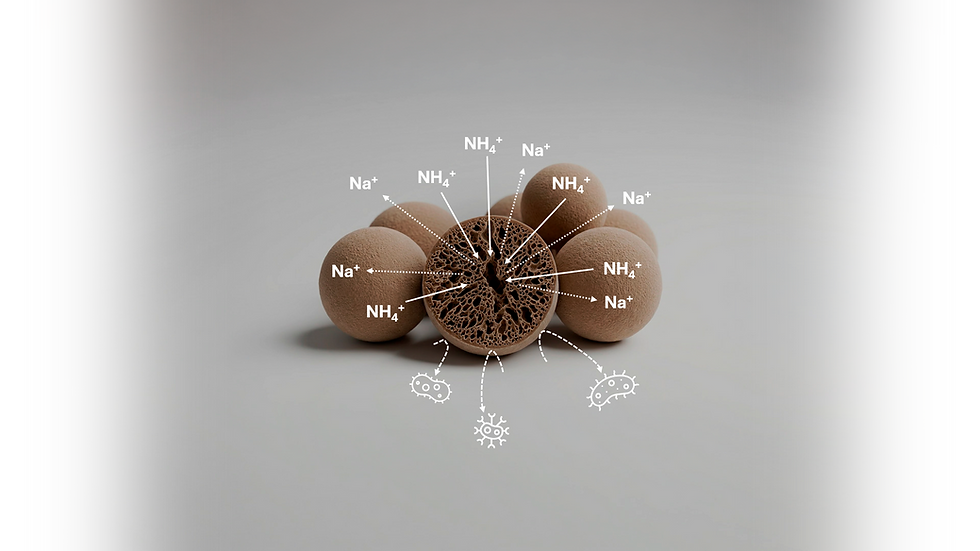
ZnHCF has a structured crystalline lattice with a strong affinity for ammonium ions. When water reaches the material, ammonium is captured while sodium is released back into the water.
This selectivity is especially important in seawater. Research published by DistanSea’s scientific team demonstrated that the material maintains a strong preference for ammonium despite the large concentration of competing sodium ions.
From Advanced Material to a Practical Product
The active ZnHCF material begins as a fine powder. In this form, it cannot be used directly in commercial transport tanks or holding systems.
DistanSea encapsulates the material, creating strong composite beads.
The bead structure:
-
Keeps the active material safely contained
-
Allows water and dissolved ammonium to reach the material
-
Protects the active material during operation
-
Enables practical handling
-
Supports repeated use and regeneration
The result is a sophisticated treatment material packaged in a form that is easy to install, remove, transport, and reuse.

Years of Deep-Tech Behind a Simple Product
Click on hotspots for more information
What We Bring to the Table
1
Ammonia enters the water
The animals continuously release ammonia during transport or holding.
2
Water reaches the beads
Water flows around and through the porous bead structure.
3
Ammonium is captured
The ZnHCF material selectively removes ammonium from the water, inhibiting the accumulation of Total Ammonia Nitrogen.
4
The beads are regenerated
After use, the captured ammonium is removed through a controlled regeneration process, restoring the beads for another operating cycle.
What Makes the Technology Unique?
Selective in seawater
The material targets ammonium even in water containing very high concentrations of competing ions.
Passive operation
The ammonia-removal process does not require bacteria, a biological-filter maturation period, or continuous chemical dosing into the tank.
Reusable
The beads can be regenerated and returned to operation, reducing dependence on disposable treatment materials.
Adaptable
The quantity of beads can be configured according to:
-
Species
-
Biomass
-
Water volume
-
Temperature
-
Transport or holding duration
-
Target ammonia level
Scientifically validated
The technology has been evaluated through laboratory research and live-animal trials involving species including gilthead seabream and European brown crab.
Published research demonstrated that selective ammonia removal improved water-quality control, extended operating time, and supported better survival following transport.
Complex to Develop. Easy to Operate.
Behind each DistanSea product are advanced chemistry, material synthesis, adsorption modelling, polymer engineering, and application-specific calculations.
The customer does not need to manage that complexity.
DistanSea configures the treatment for the specific species, biomass, water conditions, and required operating period. The customer receives a practical solution designed to fit into the existing operation.
Publications
